







We use cookies to provide a better site experience and performance. By using this website, you agree to the use of cookies. For more information, read our Cookies policies.


16 September, 2026
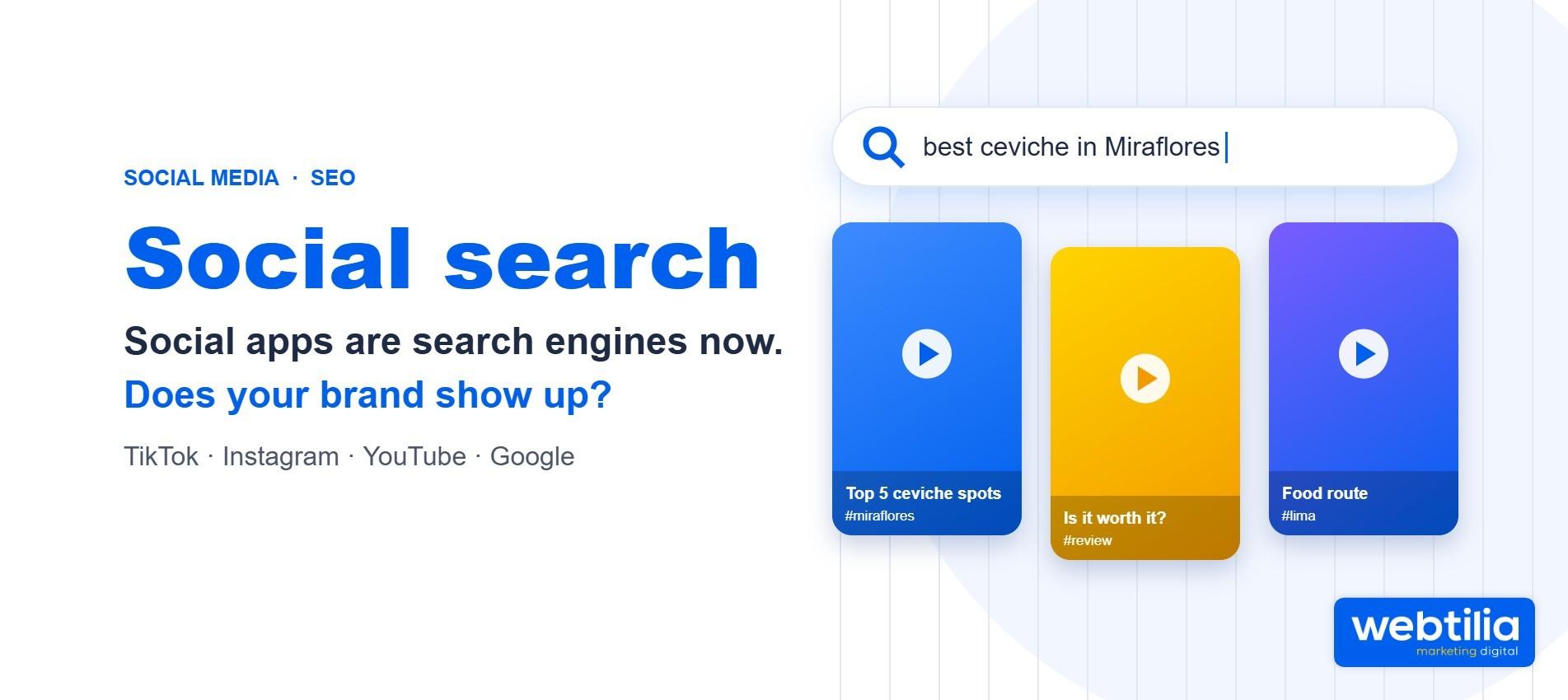
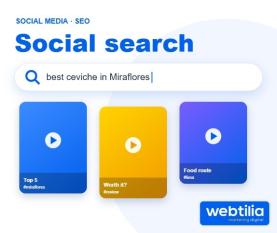
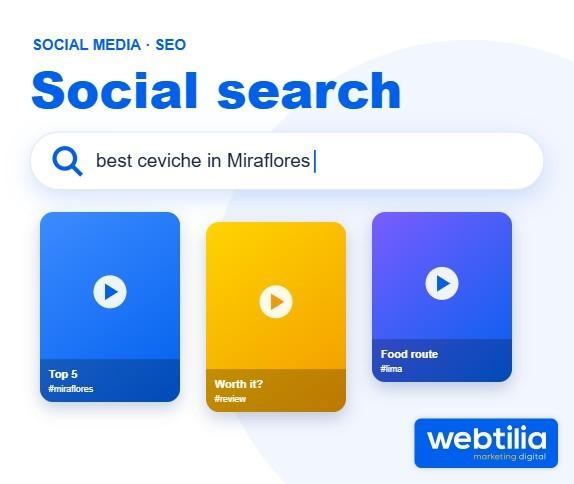
People used to open Google to find a restaurant, a dentist or a store. Today many open TikTok, Instagram or YouTube, type what they need and decide by watching other people's videos. This is called social search, and it is changing where your brand needs to show up.
For those of us who lead brands, the question has changed. It is no longer enough to know where we rank on Google; we also need to know what a person finds when they type our category, our product or their problem inside a social network. That is where more and more buying decisions are being made.
In this article we explain what social search is, what the latest data shows, what it means for brands in Peru and Latin America, how platforms decide what to show, and a concrete 90-day plan to start appearing in those searches.
The clearest signal came from Google itself. In July 2022, Prabhakar Raghavan, then a senior vice president at the company, said its studies showed that almost 40% of young people looking for a place to have lunch do not use Google Maps or Search: they go straight to TikTok or Instagram.
Recent data confirms the trend has taken hold. An Adobe Express survey conducted in the United States in early 2026 found that 49% of consumers have used TikTok as a search engine, up from 41% in 2024. Among Gen Z the figure reaches about two in three, and among millennials it is above half. The most common searches are recipes, DIY tips, beauty, music and product recommendations.
The platforms have responded. In June 2025 TikTok reported that billions of searches happen on its app every day, more than 40% above the previous year. Instagram, YouTube and TikTok have all improved their in-app search, and in July 2025 Instagram took a key step: since July 10 of that year, public posts from professional accounts (business or creator) can appear in Google and other search engine results.
The takeaway for brands is simple: your social content no longer competes only in the feed. It competes in search, inside each network and on Google as well.
It would be a mistake to read this data as the end of Google. In the same Adobe survey, 89% of Gen Z still prefer Google over other platforms, and the share of young people who rely on TikTok more than Google fell from 8% in 2024 to 4% in 2026.
What has changed is the journey. A person may discover a product on TikTok, look for reviews on YouTube, check the brand's Instagram profile, ask ChatGPT or Gemini, and end up buying through Google. Every stop is a search moment, and at each one your brand either shows up or it does not.
There is a third front that few brands are watching: social platforms feed the answers of artificial intelligence. According to Ahrefs, YouTube is now the most cited domain in Google's AI Overviews, and a Peec AI analysis of 30 million sources found that Reddit, YouTube and LinkedIn are among the sites most cited by ChatGPT, Gemini, Perplexity and Google's AI Mode. A good YouTube video does not only compete on YouTube: it can become the source of the answer an AI gives your next customer.
SEO is no longer played on a single search engine. It is played everywhere your customer asks a question: Google, social networks and AI assistants.
In Peru the shift carries even more weight. According to DataReportal's Digital 2026 report, the country had 28.4 million internet users (82% of the population) and 28.3 million active social media user identities at the end of 2025. The platforms' own advertising tools report an ad reach of 28.3 million adult users on TikTok, 24.7 million on Facebook, 21.7 million on YouTube and 11.3 million on Instagram. These are advertising reach figures rather than unique users, but they clearly show the size of the audience.
Engagement confirms TikTok's lead. The Tendencias Digitales 2026 report, based on Comscore data and covered by the newspaper El Peruano, indicates that TikTok accounts for 49% of content engagement in the country, compared with 33% for Facebook and 17% for Instagram.
For a Peruvian brand the reading is clear: TikTok is no longer an experimental channel; it is one of the main places where customers discover, compare and decide. And although Instagram has a smaller share of engagement, it now offers a strategic advantage: public posts from professional accounts can rank on Google.
| Platform | What people usually search for | Where your visibility is decided |
|---|---|---|
| TikTok | Recommendations, places, reviews, quick tutorials | On-screen text, what is said in the video, caption and subtitles |
| Brands, products, inspiration, local businesses | Profile name and category, post caption, alt text, location | |
| YouTube | Tutorials, comparisons, in-depth explanations | Title, description, chapters, subtitles and thumbnail |
| All of the above, now with video and social results | Your website and also your public social posts | |
| AI assistants | Direct answers, comparisons and recommendations | Clear, citable content on your website, YouTube and other reference platforms |
Each network has its own algorithm, but in search they all broadly combine four types of signals:
None of these signals depend on having millions of followers. That is why social search is a real opportunity for small and mid-sized brands that know their subject and can explain it well.
Profile name, category, bio and location are the first things in-app search engines read. Include what you do and where: “Dental clinic in Lima” gets found more than the brand name alone. Keep the same name, description and link across all your social profiles and your website: that consistency helps platforms, search engines and AI understand they all belong to the same brand.
TikTok and YouTube transcribe video audio. If you say “three mistakes when choosing a mattress” in the first seconds, the video has a better chance of appearing when someone searches exactly that. The same goes for on-screen text. Before recording, type your topic into the TikTok or YouTube search bar and check the suggestions: those are the phrases people actually type.
A post caption is the equivalent of SEO copy. Explain what the content is about using your customer's words, in one or two clear sentences, and put the most important part in the first line, the one visible before “more”. Now that Google indexes Instagram, that caption can also rank outside the app.
Subtitles improve accessibility and give the platform more text to understand your video. On Instagram you can edit the alt text of each image: use it to describe the image precisely. On YouTube, add chapters in the description so each part of the video can answer a different search.
Generic hashtags such as #marketing or #lima compete with millions of posts. Hashtags that describe the specific topic and search intent work better, for example #cevicheriamiraflores or #invisiblebraces.
Social searches are questions: “is it worth it?”, “how much does it cost?”, “how do I use it?”. Build a series of videos that answer your customers' real questions. It is the same logic we apply to get ChatGPT, Gemini and Perplexity to recommend a brand: answering well earns visibility.
Your next customer may never type your brand name into Google. But they will type their problem into TikTok. The question is whether your video will be there.
When a platform concentrates searches, advertising follows. In September 2024 TikTok launched Search Ads Campaign in the United States, a campaign type that shows keyword-based ads on the app's search results page, with logic very similar to Google Ads. Since then it has added keyword planning tools and impression share metrics.
Availability of these formats varies by country and account, so it is worth checking in your ads manager. Our recommendation is to build the organic foundation first (profile, content that answers questions and measurement) and then use the search terms that already perform as the starting point for investment. That way paid media amplifies proven interest instead of guessing.
Platforms already show where your views come from. These are the indicators we recommend tracking every month:
| Indicator | Where to find it | What it tells you |
|---|---|---|
| Views from search | Analytics for each TikTok video | Whether your content appears when people search |
| Search terms | YouTube Studio, “YouTube search” traffic source | The exact words your customers use |
| Reach from non-followers | Instagram insights | Whether you reach new people, not just your community |
| Branded searches | Google Search Console | Whether your social presence drives interest in your brand |
| Attributed leads and sales | UTM links, codes and CRM | Whether visibility turns into customers |
Use those search terms as a source of ideas: if people arrive searching for “dental implant prices”, that is your next video, and also a page worth having on your website. When that visitor lands on your site, make sure the page is built to convert someone who has already made up their mind.
| Stage | What to do | Expected outcome |
|---|---|---|
| Days 1 to 30: build the foundation | Optimize profiles (name, category, bio, location and links), enable the option to appear in search engines on Instagram, and list your customers' 20 most frequent questions. | Clear profiles and a topic list based on real searches. |
| Days 31 to 60: produce and publish | Publish a series of short videos answering those questions, with the keyword spoken, shown on screen and in the caption. Upload longer versions to YouTube. | First views from search and data on which topics work. |
| Days 61 to 90: measure and scale | Review traffic sources and search terms, double down on winning topics, connect them to pages on your website and evaluate search ads. | A repeatable system connecting social, web, AI and sales. |
It is the use of social networks such as TikTok, Instagram or YouTube as search engines: people type what they need inside the app and decide based on the videos and posts they find.
Yes, if your account is professional, public and the option to appear in search engines is turned on. Since July 10, 2025, Instagram allows Google to index public posts from professional accounts of users aged 18 and over.
No. It complements it. Your customers search in several places, and ideally they should find you both on Google and inside social networks, with a consistent message.
Yes, but they carry less weight than before. A few specific hashtags work best, combined with clear captions, on-screen text and keywords spoken in the video.
With your profile and your customers' most frequent questions. In search, answering well matters more than follower count, which is why small brands can compete.
Yes. TikTok offers a search campaign type that shows keyword-based ads on its results page. Availability depends on the country and account, so check it in your ads manager.
It can. AI engines frequently cite content from platforms such as YouTube, Reddit and LinkedIn. A well-explained video with a clear title, description and subtitles can become a source for those answers.
At Webtilia we combine social media strategy, content and SEO so your brand appears where decisions are made today: on Google, in AI assistants and inside social networks. Let's talk about your social media and we will show you what your customers are searching for.
By Christian Israel, CEO Webtilia Latam.

Webtilia somos una agencia de marketing digital que ofrece servicios diseñados para potenciar marcas y generar resultados tangibles. Desde estrategias de SEO y CRO avanzadas hasta campañas de publicidad pagada, social media, creatividad, desarrollo web y Growth Marketing.
